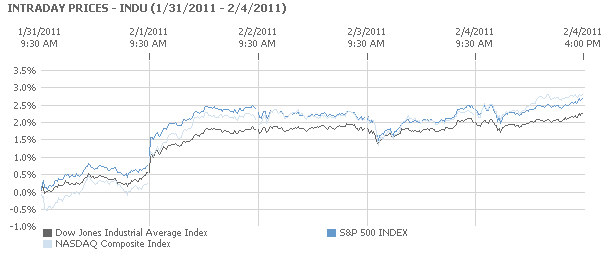
The markets continued their slow and steady climb this week, notching another 2 ½ year high along the way. For the week, both the Dow and Nasdaq rose 1.5% while the S&P was higher by 1.4%. Gold climbed 0.9% while oil dropped nearly 4% on the news out of Egypt.
 Source: MSN Moneycentral
It was a rather uneventful week for the markets this week. The most newsworthy item came on Friday with the resignation of Egyptian President Mubarak. It ushers in dramatic change for the country and region (Algeria looks like it is next), but what they are changing to remains to be seen. The event really has little impact on U.S. companies, though. The Suez Canal is very important for shipping, especially oil, so a greater impact was felt in this sector.
Inflation, especially in food prices, remains a hot topic as more commodities reach all-time highs. Just this week, several companies (Sarah Lee, LG Electronics, Pepsi, and multiple coffee companies) warned that they will be raising prices as a result of higher input costs (commodity prices). While that is obviously bad for shoppers, we can’t forget that higher costs will likely result in lower earnings for these companies. We worry that in the coming months and quarters, corporate earnings will be much lower than they presently are.
Our favorite inflation denier, Fed chief Ben Bernanke, testified before the House Budget Committee this week. Nothing new was said as he continued to deny inflation concerns both here and abroad. “Inflation remains very, very low,” he told the committee. By the metrics he looks at, he’s right. Things like the CPI and bond yields are what he looks at for signs of inflation, but they have been so skewed and manipulated that they don’t reflect much of anything.
In fact, Zerohedge.com reported this week that food prices only account for 7.8% of the CPI, something we were not aware of. Can you imagine, one of the most important metrics of consumer prices only making up that tiny percentage of the CPI! The lack of concern about this issue will result in serious problems, in our view.
Finally, having little impact on the markets but on the stock market itself, the NYSE announced it was near a deal to be bought by the German exchange, Deutsche Börse. The deal will provide better technology and scale for both companies, which is fine. The problem is, the New York Stock Exchange, which has been around since 1792, will possibly lose its name. Sure, these renamings happen often in acquisitions in our increasingly global economy, but the fact that an icon of American capitalism may lose its name and identity is troubling.
The Wall Street Journal had an excellent editorial on this subject this week. The sale of this American icon is representative of America’s diminishing power in the world. At one point, the NYSE was the dominant force that acquired many other exchanges. New rules and regulations like Sarbanes Oxley has driven much of their business offshore and left the NYSE weak. This is symbolic of the decline of America in general as even more regulation has come down the pipe and business opportunities are increasingly found abroad.
Next Week
It will be a busier week next week as we get data on housing, retail sales, industrial production, and the Producer and Consumer Price Indexes (PPI and CPI), which the government uses as a gauge of inflation. We are most interested in the PPI and CPI to see if the rise in commodity prices has resulted in any gains in the indices. Like we mentioned above, the things people actually purchase are underrepresented these indexes, so we doubt there will be much of a gain here.
Corporate earnings will continue to come in at a steady pace next week. Results have been fairly decent so far with the exception of a few hiccups. We expect for earnings to continue to be strong here.
Also making news next week will be the budget proposed by President Obama on Monday. Dramatic cuts are necessary and all the talk of “new investments” is troubling. The only cuts we have heard about so far have been in the Defense Department, so any other spending cuts would certainly be welcome. When did cutting spending become such a radical idea, anyway?
Where are we investing now?
No change here. The market continues to climb in a practical straight line upwards and we are just going along for the ride. Since the beginning of September, the Dow and S&P are up over 23% and 26%, respectively, while the Nasdaq is over 30% higher! Such a fast rise without a correction is troubling and everything looks expensive at these levels, so we remain cautious. Fundamentals like employment have not been that good and in normal times, we would be betting against the market at these levels. With the Fed’s printing press in high gear to make sure the market keeps going up, it becomes tough to bet against it.
In order to avoid the market manipulation by the Fed, the high frequency traders, and hedge fund algorithms, we are increasingly turning to smaller and less popular individual stocks. The lack of correlation to these other factors is a nice change. By no means is this a major portion of our portfolios, but something we have been giving more attention to.
We aren’t looking to do much more buying at this time, but if the opportunity presents itself, in equities we are focused on large cap higher-quality and multi-national stocks. Large cap has lagged Mid and Small, so there could be more room to run in this area. We continue to avoid banking and insurance sector stocks. TIPs are important as we expect inflation to increase in the future, while U.S. Treasuries are a sector we are very bearish (pessimistic) on as we think yields will increase over time.
Commodities remain a long term favorite and any weakness could present buying opportunities. Municipal bonds are still important despite the recent drop in prices. There are some nice yielding bonds out there now (try to avoid muni funds and buy the actual bond if possible). Finally, international stocks have had a significant run already and are facing many headwinds for the future, especially inflation. Still, if we had to put new money in, we are favoring developed international markets as opposed to emerging.
 Source: MSN Moneycentral
It was a rather uneventful week for the markets this week. The most newsworthy item came on Friday with the resignation of Egyptian President Mubarak. It ushers in dramatic change for the country and region (Algeria looks like it is next), but what they are changing to remains to be seen. The event really has little impact on U.S. companies, though. The Suez Canal is very important for shipping, especially oil, so a greater impact was felt in this sector.
Inflation, especially in food prices, remains a hot topic as more commodities reach all-time highs. Just this week, several companies (Sarah Lee, LG Electronics, Pepsi, and multiple coffee companies) warned that they will be raising prices as a result of higher input costs (commodity prices). While that is obviously bad for shoppers, we can’t forget that higher costs will likely result in lower earnings for these companies. We worry that in the coming months and quarters, corporate earnings will be much lower than they presently are.
Our favorite inflation denier, Fed chief Ben Bernanke, testified before the House Budget Committee this week. Nothing new was said as he continued to deny inflation concerns both here and abroad. “Inflation remains very, very low,” he told the committee. By the metrics he looks at, he’s right. Things like the CPI and bond yields are what he looks at for signs of inflation, but they have been so skewed and manipulated that they don’t reflect much of anything.
In fact, Zerohedge.com reported this week that food prices only account for 7.8% of the CPI, something we were not aware of. Can you imagine, one of the most important metrics of consumer prices only making up that tiny percentage of the CPI! The lack of concern about this issue will result in serious problems, in our view.
Finally, having little impact on the markets but on the stock market itself, the NYSE announced it was near a deal to be bought by the German exchange, Deutsche Börse. The deal will provide better technology and scale for both companies, which is fine. The problem is, the New York Stock Exchange, which has been around since 1792, will possibly lose its name. Sure, these renamings happen often in acquisitions in our increasingly global economy, but the fact that an icon of American capitalism may lose its name and identity is troubling.
The Wall Street Journal had an excellent editorial on this subject this week. The sale of this American icon is representative of America’s diminishing power in the world. At one point, the NYSE was the dominant force that acquired many other exchanges. New rules and regulations like Sarbanes Oxley has driven much of their business offshore and left the NYSE weak. This is symbolic of the decline of America in general as even more regulation has come down the pipe and business opportunities are increasingly found abroad.
Next Week
It will be a busier week next week as we get data on housing, retail sales, industrial production, and the Producer and Consumer Price Indexes (PPI and CPI), which the government uses as a gauge of inflation. We are most interested in the PPI and CPI to see if the rise in commodity prices has resulted in any gains in the indices. Like we mentioned above, the things people actually purchase are underrepresented these indexes, so we doubt there will be much of a gain here.
Corporate earnings will continue to come in at a steady pace next week. Results have been fairly decent so far with the exception of a few hiccups. We expect for earnings to continue to be strong here.
Also making news next week will be the budget proposed by President Obama on Monday. Dramatic cuts are necessary and all the talk of “new investments” is troubling. The only cuts we have heard about so far have been in the Defense Department, so any other spending cuts would certainly be welcome. When did cutting spending become such a radical idea, anyway?
Where are we investing now?
No change here. The market continues to climb in a practical straight line upwards and we are just going along for the ride. Since the beginning of September, the Dow and S&P are up over 23% and 26%, respectively, while the Nasdaq is over 30% higher! Such a fast rise without a correction is troubling and everything looks expensive at these levels, so we remain cautious. Fundamentals like employment have not been that good and in normal times, we would be betting against the market at these levels. With the Fed’s printing press in high gear to make sure the market keeps going up, it becomes tough to bet against it.
In order to avoid the market manipulation by the Fed, the high frequency traders, and hedge fund algorithms, we are increasingly turning to smaller and less popular individual stocks. The lack of correlation to these other factors is a nice change. By no means is this a major portion of our portfolios, but something we have been giving more attention to.
We aren’t looking to do much more buying at this time, but if the opportunity presents itself, in equities we are focused on large cap higher-quality and multi-national stocks. Large cap has lagged Mid and Small, so there could be more room to run in this area. We continue to avoid banking and insurance sector stocks. TIPs are important as we expect inflation to increase in the future, while U.S. Treasuries are a sector we are very bearish (pessimistic) on as we think yields will increase over time.
Commodities remain a long term favorite and any weakness could present buying opportunities. Municipal bonds are still important despite the recent drop in prices. There are some nice yielding bonds out there now (try to avoid muni funds and buy the actual bond if possible). Finally, international stocks have had a significant run already and are facing many headwinds for the future, especially inflation. Still, if we had to put new money in, we are favoring developed international markets as opposed to emerging.