Tuesday, June 1, 2021

Commentary for May, 2021

Hello all – we hope you had a nice May.

Stocks closed the month not far from where they started.  The Dow rose 1.9%, the S&P 500 added 0.7%, and the Nasdaq was down 1.5%. 


The markets moved lower in the early part of the month, but the selling proved to be a good buying opportunity as stocks rebounded into the end of May.


_____
 
 
 May was a fairly uneventful month for the markets without a lot of news.  Mostly, it was a continuation of the themes of the last few months.  The economy is rebounding as the country reopens and inflation is rising.

Actually, the inflation story was probably the big story of the month.  The CPI and PPI inflation reports released this month showed inflation rising sharply.  

These reports kicked off a decline in stocks, since higher inflation likely means the Fed will pull back on its stimulus.  However, many Fed members took to the airwaves to declare that the Fed was not concerned about inflation and will not pull back on their stimulus any time soon.  That helped stocks move higher.

The Fed has targeted 2% as their inflation goal (the latest CPI report was at 4.2%).  Several Fed members stated that since inflation had been below 2% for a few years, they needed to see inflation above 2% for several years to balance it out.  

Further, they believe this surge in inflation is temporary.  That may be so.  But even if inflation next year is 0%, we’re already at this higher price level that is squeezing average Americans.  

We strongly believe the Fed is wrong with this policy.  Their mandate is for stable prices, which would mean 0% inflation.  Not only is 2% is an arbitrary number they derived out of thin air, but it’s also a destructive policy, particularly to middle- and lower-class Americans.  Imagine 2% inflation for 10 years - you just lost 20% (plus the compounding) over that time period.  How is that helpful?  

This is a very dangerous policy that we don’t believe is even legal for them to pursue.  

Here's a look at 20 years of inflation at the consumer level - the CPI (consumer price index).  We can see the sharp rise recently, plus we can see how it’s clearly averaged more than 2% during that time.


Inflation at the business level - the PPI (producer price index) - had its biggest gain since 2009.


Here’s a look at the price increases in some popular commodities over the past year:


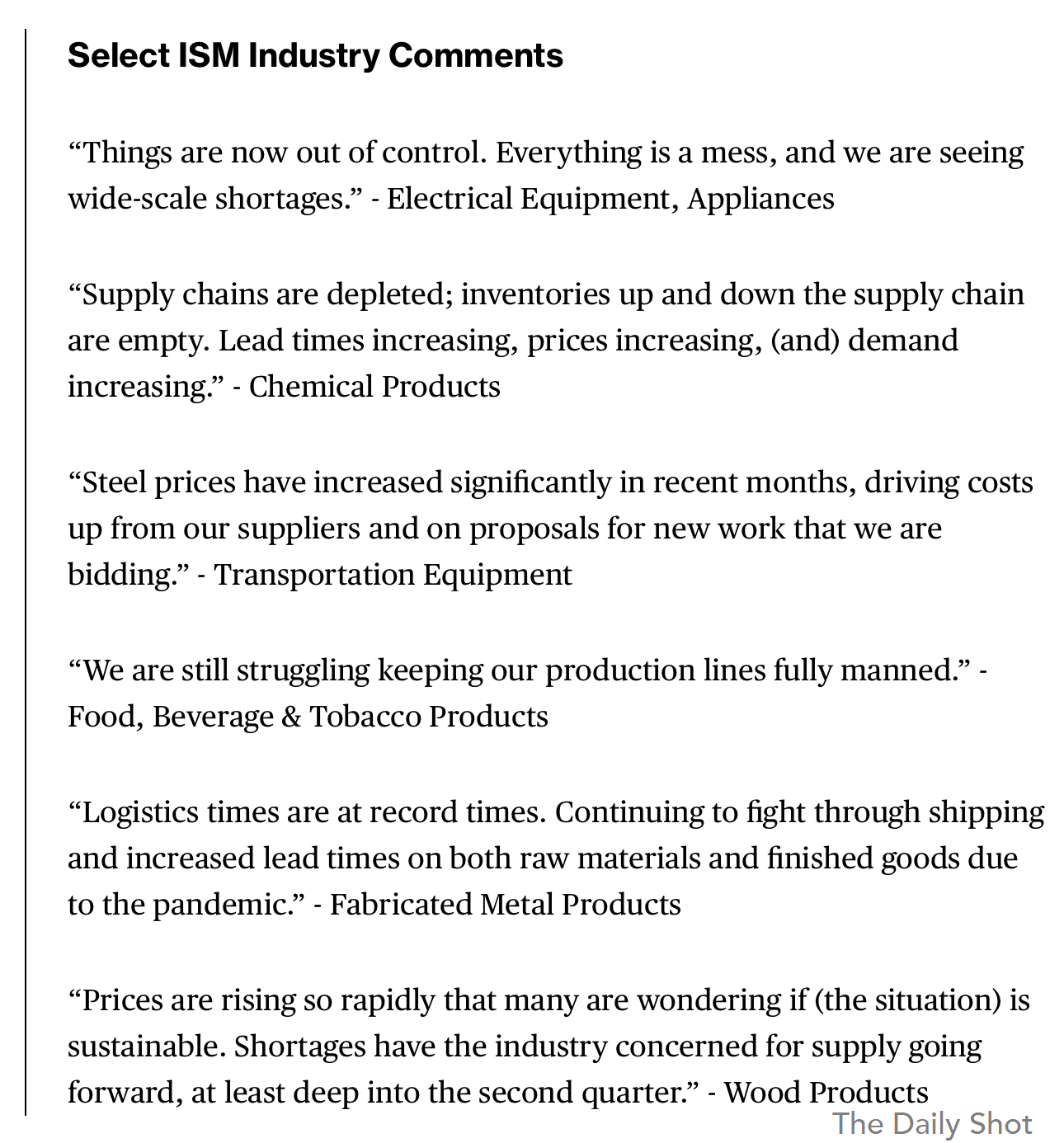
Manufacturing companies cite these higher prices as a major headwind in their business.


One last chart on inflation shows that the public is becoming concerned about inflation as Goggle searches on the subject have increased.


_____
 
 
Switching gears to the economy, where the jobs picture continues to improve but economic data wasn’t as strong as the previous month.  

The weekly employment report showed fewer people filing for unemployment.


There are a lot of jobs out there, but they aren’t getting filled.  Last month had a record 8.1 million job openings.  As the chart says, “that’s a lot.” 


Small businesses continue to have a hard time filling jobs. 


Last month we also saw the strength of the manufacturing and service sectors tick lower, but they both remain strong.


Retail sales were also lower, but this was more because the previous months’ measurements had been so strong and hard to sustain.


Finally, confidence surveys show confidence growing amongst small businesses, but stalling amongst consumers.


 _____
 
 
Where does the market go from here?  

Stocks had a nice bounce back from the sell-off earlier this month.  There may be a little room to move higher, but from a shorter-term perspective, this isn’t an ideal point to put new money into the broader indexes.  Individual stock selection would do better here, but there’s not a lot of attractive-looking investments out there now.    


This commentary is for informational purposes and is not investment advice, an indicator of future performance, a solicitation, an offer to buy or sell, or a recommendation for any security. It should not be used as a primary basis for making investment decisions. Consider your own financial circumstances and goals carefully before investing. Past performance cannot guarantee results.

Monday, May 3, 2021

Commentary for April, 2021

Hello all – we hope you had a nice April.

It was another good month for stocks as the markets keep chugging higher.  The Dow rose 2.7%, the S&P 500 added a solid 5.2%, and the Nasdaq did the best with a 5.4% gain. 


The steady rise in the market over the last year has many worried that a pullback is due.  Indeed, there are some signs of froth we can point to.  One example is investors becoming the most optimistic they’ve been in the last two years, which often happens at market highs.


Another sign is a large amount of corporate insiders selling the stock of their companies, which is also a sign that stocks are expensive. 


However, we aren’t too concerned about a pullback at this point.  We’ll discuss this more later in the commentary.  
 
_____
 
 
We have a ton of charts this month, so this commentary will be less words and more pictures.  This is good, too, since there wasn’t a lot of new news moving the markets this month. 

Corporate earnings for the first quarter did make headlines and have been extremely solid, but they didn’t have much impact on the overall market.  A year ago was the bottom in the pandemic, so year-over-year numbers will naturally look good.  It’s how the future looks that is of interest to investors.    

The markets keep moving higher more because of the Fed keeping its stimulus in place and the Biden administration announcing more government spending.  This will have a boost to the economy - until the bill comes due and tax hikes take their bite.  

_____


All this spending and money printing is leading to a lot of concerns about inflation, and we’ll spend the bulk of this commentary on the subject.  

The inflation reports from the government do show inflation kicking in, especially for businesses (who have to decide if they will raise prices to cover the costs or keep prices low and cut into profits).  Here's a look at the price index for businesses (the PPI):


We think the inflation story is much worse than advertised.  Businesses are reporting large increases in prices and have discussed it during their earnings calls.  


Below we’ll show charts of common expenses for businesses and you can see how the prices have jumped recently. 


It’s not just these commodity prices that are rising, but the cost of employees is rising, too.  

Businesses have to compete with the generous unemployment benefits from the federal government.  The federal government offers $300 per week in unemployment, in addition to what is already provided by the state.  In some states, an unemployed person can make over $6,000 per month (for example, the State of Massachusetts pays up to $1,234 per week).  That’s pretty darn good.  Plus there’s the stimulus payments, like the recent $1,400 and the $600 prior to that.  

Because of this, businesses are having a hard time finding workers since people make more money on unemployment than they do by working.  

The amount of job openings currently stands at a record high:


A record amount of businesses say they’ve had a hard time finding workers.  Amazingly, 91% of respondents to a NFIB survey reported few or no qualified applicants to job openings.


Here’s a real-life example from Tampa, FL.  A McDonald’s restaurant was offering $50 to people just to come in for an interview.  The owner said it was the worst hiring environment he’d ever seen.    


All these rising prices for businesses mean rising prices for the products we buy.  Unfortunately for us, it’s not just those prices in the stores that are rising, but prices for nearly everything around us are rising.

Housing prices are at a record high:


Car prices are at a record high:


 Gas prices are rising, too:


History suggests these price increases are just beginning.  Inflation tends to rise when the government prints money, and we haven’t yet seen the spike in inflation to match the amount of money the government has printed. 


 _____
 
 
Switching gears to the economy, which continues to look solid.  

Economic strength measured by the GDP report shows another solid gain, though it’s an easy measurement over a year weakened by the shutdowns. 


Below are several other economic charts that all show an economy that continues to strengthen.


 _____
 
 
Where does the market go from here?  

As we mentioned earlier, the market does look a little frothy.  While there may be some weakness in the short term, we don’t think a large decline is in store.  

As we saw during the Obama administration, the consequences of bad economic policies are not felt when the Fed prints record amounts of money and keeps the markets inflated.  We believe this will end badly, but no one can predict when that will be.

In the short term, we’d avoid putting new money in the broader indexes and instead look for undervalued individual stocks.   


This commentary is for informational purposes and is not investment advice, an indicator of future performance, a solicitation, an offer to buy or sell, or a recommendation for any security. It should not be used as a primary basis for making investment decisions. Consider your own financial circumstances and goals carefully before investing. Past performance cannot guarantee results.

Thursday, April 1, 2021

Commentary for March, 2021

Hello all – we hope you had a nice March.

It was another positive month for the markets.  The Dow was up a solid 6.6%, the S&P 500 gained 4.3%, and the Nasdaq was again the laggard with a 0.4% return.  
This was also the end of the first quarter.  The Dow returned 7.8% over that time, the S&P added 5.8%, and the Nasdaq rose 2.8%.


This month was a funny one because the three main indexes seemed to move in different directions every day.  

At the end of the day, when someone would ask “How did the market do?”, you usually couldn’t give an easy answer of “up” or “down.”  The Dow might have been up but the Nasdaq was down, or vice-versa.  The indexes tend to move together about 80% of the time.  As you can see in the chart below, this month it dropped down to near 60%.


Here’s how the markets looked over the course of the month:


So, what’s going on?   It seems to be a continuation of a trend that started last month.  Investors are rotating out of previous high flyers like tech stocks, which are a large portion of the Nasdaq index.  Then they’re moving into investments that had been underperforming, thinking they have more room to rise.  

Tech stocks that don’t make money excelled in 2020, but have dropped sharply this year (how nice would it be to have a company that doesn’t make money, but still see your stock rise?).


_____
 
 
Bonds were again a big story this month.  Their price continues to fall and their yields rise.  That means in your investment account, you’ll see your bond holdings lost value but the interest you earn will be higher.


 _____
 
 
There wasn’t a lot of market-moving news this month.  The economy continues to slowly reopen, with Covid cases falling and vaccinations rising.

The government also looks prepared to do another massive stimulus/infrastructure program.  The latest bill again looks like more of a Democrat policy wish-list rather than stimulus that will produce tangible benefits, but trillions flooding the market will likely push markets higher.

It looks like massive tax increases could accompany this latest bill, too.  That will be a negative for businesses - but not necessarily bad for the market.  We saw this under the Obama administration.  Their economic policies were nothing short of horrendous and we even saw a recession in corporate earnings - yet the market moved higher.  This was largely due to the record amounts of stimulus (printed money) being injected in the economy.  

The Fed has made it clear that they have no intentions of pulling back on the stimulus any time soon, so it may continue to help the markets.

We worry that this unprecedented level of stimulus and government spending will have severe negative long-term consequences, but there doesn’t appear to be any concerns right now.  

 _____
 
 
Switching gears to the economy, which was a mixed bag this month.  There were a lot of issues associated with the winter weather and big Texas freeze back in February, causing some distortions in economic data.  

Retail sales, durable goods, and industrial production all saw declines, and all were attributed to the weather.


The strength of the manufacturing and service sectors took a dip lower, too.


Comments from the companies they poll to get this data were interesting, too.  Many of them are seeing issues with inflation and having a hard time finding employees.


Here’s a look at inflation levels at the Producer (manufacturer) level, showing inflation rising:


Interestingly, the Fed puts out data on manufacturing by region in the U.S., and they are all showing significant strength.  The Philadelphia region was especially notable, rising quickly to its third-highest level on record. 


The employment picture looks to be improving, too, as fewer people are filing for unemployment.


Lastly, confidence appears to be picking up, with both the general public and with small businesses.


 _____
 
 
Where does the market go from here?  

The overall markets look pretty unattractive on a short-term basis (looking out a couple weeks).  Now is a better time to look for undervalued individual stocks.   

We’re a little more cautious for the longer term.  We think the economy will continue to improve, but the froth in the markets, along with a steady increase in inflation, could have the markets looking different in the future.  


This commentary is for informational purposes and is not investment advice, an indicator of future performance, a solicitation, an offer to buy or sell, or a recommendation for any security. It should not be used as a primary basis for making investment decisions. Consider your own financial circumstances and goals carefully before investing. Past performance cannot guarantee results.