Tuesday, March 1, 2022

Commentary for February, 2022

Hello all - we hope your February was a nice one.

It wasn’t a great month for the markets, with the Dow lower by 3.5%, the S&P 500 lost 3.1%, and the Nasdaq, which has a higher concentration of technology companies, was down 3.4%.


February may be the shortest month, but it packed a lot of action into it.  

Stocks opened the month higher, but fell as it looked like the Fed was poised to pull back on their stimulus even more than expected.  Putin’s invasion into Ukraine caused even more selling.  Stocks posted a slight rebound late in the month as bargain-hunting investors tried to find some cheap deals. 


 _____
 
 
Russia was the big story this month, which shouldn’t be a surprise.  The markets have been very volatile this year and the Ukraine news kept that volatility high. 


In fact, the markets have been so volatile that the Nasdaq index even saw a 7% move in one day - that’s something that hasn’t happened since the financial crisis over a dozen years ago!


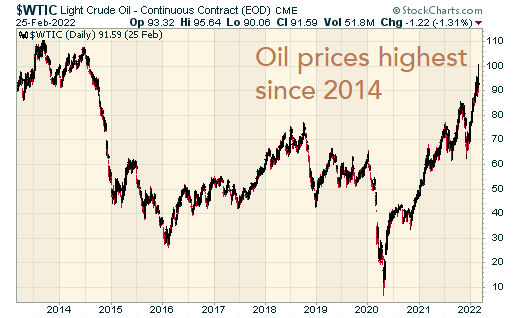
Commodities saw even more volatility than stocks.  With Russia being such a large oil producer, our already-high oil prices shot up to levels we haven’t seen since 2014.

 
Gold investors did well, though, as investors looking for safety found it in gold.


Not surprisingly, the Russian stock market fell sharply.


How much will this war impact our markets?  We still must see how much it escalates, but in reality, it will have little impact on our economy and our businesses.  For the companies in the S&P 500, only 1% of their revenue comes from either Russia or Ukraine.  

However, the commodity markets will see more of an impact.  Oil prices, as the earlier chart shows, will rise and so will our gas prices at the pump.  They are also big exporters of other commodities like wheat, so these products will also see higher prices.  

Overall, though, markets have historically moved higher during times of war (we think the decline in 2001 was more due to the dot-com bust at that time).  


 _____
 
 
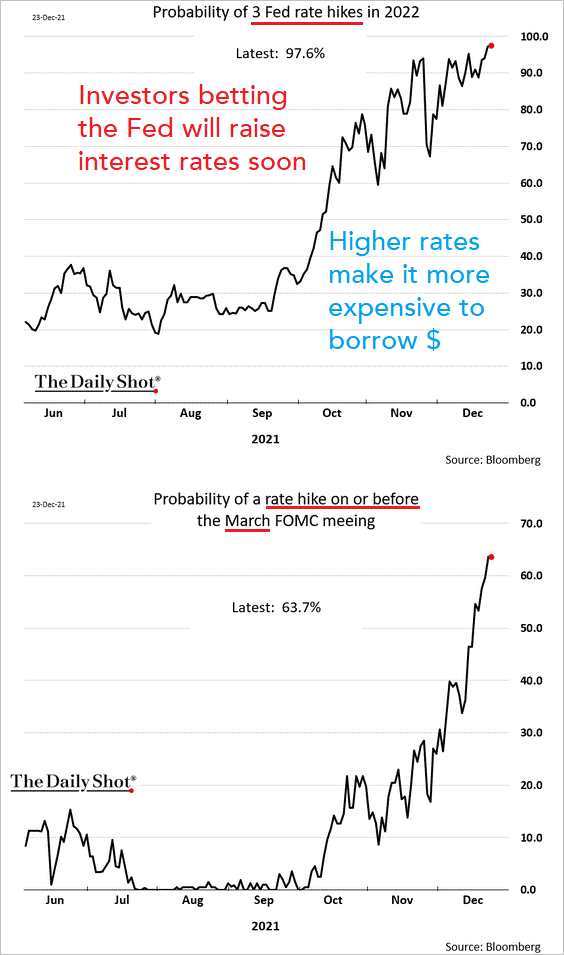
While the war grabbed headlines, the Fed is still likely to have the biggest impact on our markets.  

The Fed has been widely expected to pull back on their stimulus and because inflation is so high, many investors believed the Fed will pull back significantly.  However, the war made a large pullback less likely and this news actually helped stocks rise at the end of the month.  

The chart below shows how much investors think the Fed will pull back on their stimulus.  Without going into the specifics of the chart, you can clearly see how it reversed course in February, indicating investors don’t think the Fed would pull back on their stimulus as much as originally believed. 


 _____
 
 
The economic data out this month was mostly poor.  

Inflation, again, was the big topic as the inflation levels remain high.  The consumer price index, or CPI, again hit its highest level in 40 years.


Inflation at the business level (the PPI) moved slightly lower last month, though it still remains very high. 


Small businesses are especially concerned with inflation.  Bigger companies are better able to raise prices to offset these higher costs, but its more difficult with small businesses.


Both the manufacturing and service sectors weakened for the second-straight month.


Retail sales were higher…


…but it may be that people are spending more because inflation is higher. 


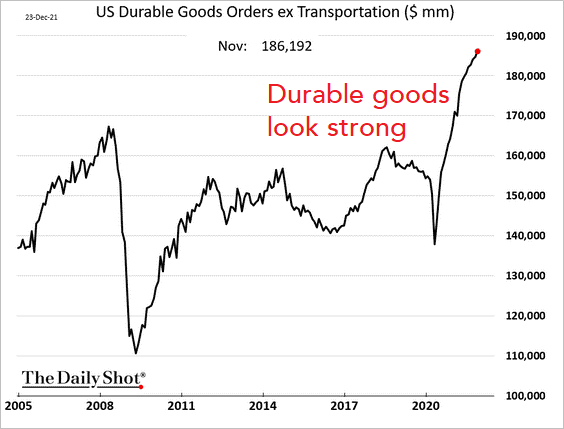
Durable goods - which are items with a longer life, like a phone or dishwasher - keep rising. 


Sentiment among the general public is low and falling.


Small business owners are a little less optimistic.


 _____
 
 
Where does the market go from here?

Stocks look very oversold (cheap) and due for a rebound, but that doesn’t mean they can’t go lower as the Ukraine fight evolves.  As we discussed earlier, wars have historically been good buying opportunities.

We don’t think any rise will last long, though.  The days of the market steadily rising are probably over as the Fed removes more and more of its stimulus, economic growth slows, and the chance of a recession increases.  There may be buying opportunities from time to time, but we think they will be short-lived.  


This commentary is for informational purposes and is not investment advice, an indicator of future performance, a solicitation, an offer to buy or sell, or a recommendation for any security. It should not be used as a primary basis for making investment decisions. Consider your own financial circumstances and goals carefully before investing. Past performance cannot guarantee results.

Tuesday, February 1, 2022

Commentary for January, 2022

Hello all - we hope your year got off to a better start than it did for the markets.   

There’s an old saying on Wall Street that “as goes January, so goes the year.”  Let’s hope that’s not the case this year as stocks had their worst month since March, 2020, when the pandemic was in high gear.  

For the month, the Dow fell 3.3%, the S&P 500 lost 5.3% - its worst January since 2009 - and the Nasdaq, which has a higher concentration of technology companies, was down 9.0% - nearly its worst January ever.


Here’s a look at the three major indexes this month:


Although January was rough, it could have been worse.  The first three weeks were the worst EVER start to the year for the S&P 500. 


Needless to say, volatility picked up in a big way this month.  Stocks saw big swings every day - some days the market would be several percentage points higher to start the day, only to finish several percentage points lower (and vice-versa).  It’s very rare to see trading like this. 


 _____
 
 
So, what’s going on?  Why all the volatility?

It’s all about the Fed.

Really, it’s been all about the Fed for many years now.  They’ve printed so much money through their stimulus in order to keep interest rates low, and that’s flowed into the stock market and propped up stock prices.  

Bad news.  Good news.  It hasn’t mattered.  The stimulus is like a pain killer that keeps the market flowing higher.    

Take a look at stocks since 2008 - does this look like a normal market to you?


However, it’s clear the party is ending.  The high inflation levels are forcing the Fed to pull back on their stimulus and like a drug addict losing its fix, the markets are not happy about it.  

In early January, the minutes from their December meeting were released and they suggested the Fed would be more aggressive in pulling back the stimulus.  The markets weren’t happy, falling the most ever on a Fed minutes day.


Later in the month, the Fed held one of their policy meetings.  Again, the Fed showed it was willing to pull back on their stimulus even more than expected and stocks fell sharply on the news.


We think the massive amounts of selling we saw this month may have been an overreaction.  Yes, the Fed will pull back its stimulus soon, but historically, the markets tend to do fairly well until a few months into the reduction of stimulus.  Of course, this time could be different since we’re in unchartered territory and have never seen this amount of stimulus before.  

We’ll talk more about our outlook for the market later in this commentary.

_____
 
 
Switching gears, corporate earnings were in focus as results from the fourth quarter started coming in.

Earnings haven’t been too impressive, although only about a third of the companies in the S&P 500 have reported so far.  There have been a few standouts, like Apple and Microsoft, but many companies still have supply-chain problems and high inflation issues, but many see these problems fading later in the year.  

_____


As for economic data, we’ll start with what everyone’s talking about, and that’s inflation.

Inflation at the consumer level, the CPI, again hit its highest level in 40 years.


Inflation at the business level (the PPI) moved slightly lower last month, though it still remains very high. 


Small businesses are especially concerned with inflation.  Bigger companies are better able to raise prices to offset these higher costs, but its more difficult with small businesses.


Other economic data looks mixed.  Economic growth in the fourth quarter, measured by the GDP, was very strong.


However, both the manufacturing and service sectors weakened.


Retail sales turned lower:


While durable goods - which are items with a longer life, like a phone or dishwasher - keep rising. 


Sentiment among the general public took a turn lower…


While small business owners became a little more optimistic…


 _____
 
 
Where does the market go from here?

Stocks looked very oversold (cheap) late in the month and overdue for a rebound, which did appear the last two days of the month.  

Below is a big image with some of the indicators we follow, showing how oversold they were.  We won’t go into what the indicators are or how they work, but you can see they were at an extremely low level and that usually results in a rebound.


This commentary is for informational purposes and is not investment advice, an indicator of future performance, a solicitation, an offer to buy or sell, or a recommendation for any security. It should not be used as a primary basis for making investment decisions. Consider your own financial circumstances and goals carefully before investing. Past performance cannot guarantee results.

Monday, January 3, 2022

Commentary for December, 2021

Welcome to 2022!  We hope you had a great December and holiday season.  

December lived up to its reputation as one of the best months of the year as the indexes closed near all-time highs.  For December, the Dow rose 5.4%, the S&P 500 gained 4.5%, and the Nasdaq, which has a higher concentration of technology companies, was up 0.7%.

It's been a solid year for the markets, too.  In 2021, the Dow rose 19%, the S&P was up a solid 27%, and the Nasdaq climbed 21%.


_____
 
 
As for the events behind the market moves this month, much of the focus was on the latest strain of Coronavirus and the Fed.

Late November saw a strong sell-off in stocks as the new Omicron strain emerged.  That sell-off hit the markets in the early part of December, too.  However, stocks turned around and rose higher as it became more apparent that this strain was less severe.

_____
 
 
The Fed was the other big story this month as they held their final policy meeting of the year.  Because inflation is running hot, they announced they would pull back on their stimulus even faster.  

First, they will do a quicker wind-down of the program where they print money to buy bonds in order to keep borrowing costs low.  

Additionally, they expect to raise interest rates even faster next year, which will also raise borrowing costs.  

These programs have had a big impact on inflating the stock market.  As they are removed, we expect to see stocks lose that tailwind and become more volatile. 

 
_____
 
 
Also, this month the Fed officially stopped using the word “transitory” when referring to inflation.  As we all know, inflation is high and keeps rising and the Fed has been wrong on this subject for a long time.  As a point of interest, the Fed employs over 400 PhD economists - it amazes us how the Fed can be so wrong, so often.  

Data out this month showed inflation at the consumer level (what we pay in the stores) is up 6.8% over the past year, the highest level in 39 years. 


Another way of looking at inflation is at the producer level, or what businesses pay before passing the cost on to shoppers.

Inflation at the producer level (or PPI) is again at its highest level ever.


_____
 
 
As for other economic data, the data released this month still shows decent economic growth.  

The manufacturing and service sectors of our economy both remain strong.


Retail sales are higher - but that’s only showing that people spent more at stores.  Are they buying more things, or are they just paying more for the same or maybe even fewer things?  It’s hard to tell from the data. 


Durable goods - which are items with a longer life, like a phone or dishwasher - keep rising. 


Sentiment among the general public has been optimistic…


But small business owners have been less optimistic…


 _____
 
 
Where does the market go from here?

Stocks are on the expensive side in the short term, based on the indicators we follow.  However, we aren’t seeing signs of a significant pullback in the near-term.  We aren’t excited about putting new money into the broader indexes at this level - we are neither buying or selling here.  


This commentary is for informational purposes and is not investment advice, an indicator of future performance, a solicitation, an offer to buy or sell, or a recommendation for any security. It should not be used as a primary basis for making investment decisions. Consider your own financial circumstances and goals carefully before investing. Past performance cannot guarantee results.

Wednesday, December 1, 2021

Commentary for November, 2021

Hello all – we hope you had a nice November.  Hard to believe we are already in December.  

Stocks started the month moving higher, only to stall and move quickly lower at the end of the month.  For all of November, the Dow fell 3.7%, the S&P 500 lost 0.7%, and the Nasdaq, which has a higher concentration of technology companies, was up 0.3%.


 _____
 
 
There wasn’t a lot going on this month to move markets.  Corporate earnings for the third quarter have wrapped up and they were pretty decent.  Economic data, too, has been fairly decent.  But neither were enough to move markets much this month.

The Fed did announce that they would begin pulling back on one of their stimulus programs, where they print money to buy bonds in order to keep borrowing costs low.   This stimulus has been helpful in keeping the markets elevated, so its gradual reduction is removing part of the tailwind for stocks.

A new factor re-emerging at the end of the month was the Coronavirus, as you are probably well aware.  The new strain doesn’t seem as “scary” as the others, but that hasn’t kept the markets from selling off.  The news actually caused the worst day of the year for stocks.

 _____
 

The new Coronavirus has many investors believing the Fed will be less likely to pull back further on their stimulus.  


 _____
 
 
The Fed has also been in the hot seat over the high level of inflation.  They’ve called it “transitory” for many months, but inflation keeps rising.  

Data out this month showed inflation at the consumer level (what we pay in the stores) is up 6.2% over the past year, the highest level in 30 years. 


Of course, the way they calculate inflation has changed over the years (to conveniently make inflation look lower).  If we measured inflation the way they calculated it 30 years ago, inflation would be closer to 10% - much higher than the way it is reported now.

 
Another way of looking at inflation is at the producer level, or what businesses pay before passing it on to shoppers.

Inflation at the producer level (or PPI) currently stands at its highest level ever.


 _____
 
 
As for other economic data, the trend still looks pretty good.  

More people are finding work and less are applying for unemployment.


The manufacturing and service sectors of our economy both remain strong.


Retail sales are higher - but that is only measuring that people spent more at stores.  Are they buying more things, or are they just paying more for the same or maybe even fewer things?  It’s hard to tell from the data. 


Durable goods - which are items with a longer life, like a phone or dishwasher - were slightly lower. 


Sentiment has been falling, however.  The general public is less optimistic:


Small businesses owners are less optimistic, too:


 _____
 
 
Where does the market go from here?  

Stocks may have a few tailwinds going for it here.  We are now entering December, which tends to be one of the best months for stocks. 


Additionally, stocks have tended to bounce back after sharp rises in volatility. 


While these are positives, there’s still a lot of unknowns.  We have the Coronavirus, the Fed pulling back on its stimulus, and another debt ceiling fight approaching.  

This December could be a volatile one.  


This commentary is for informational purposes and is not investment advice, an indicator of future performance, a solicitation, an offer to buy or sell, or a recommendation for any security. It should not be used as a primary basis for making investment decisions. Consider your own financial circumstances and goals carefully before investing. Past performance cannot guarantee results.