Saturday, November 18, 2017

Commentary for the week ending 11-17-17

It’s hard to believe Thanksgiving is almost here, but since it is next week, there will be no market commentary.

Volatility picked up this week as markets closed with mixed results.  For the week, the Dow was lower by 0.3%, the S&P was relatively flat with just a 0.1% decline, and Nasdaq was higher by 0.5%.  Bond prices were mostly higher as their yields moved lower.  Gold had a nice week, up 1.6%.  Oil prices had their first down week in six weeks, off 0.2% to $56.68 per barrel.  The international Brent oil moved lower to close at $62.72.

Source: Google Finance


There were a few stories impacting the markets this week, from economic data to corporate earnings and news out of Washington.  However, the market itself was the big story as volatility picked up.  This week stocks had both their worst day and best day since early September. 

Stocks have had quite a run over the last several months as they have steadily risen.  In fact, until a pullback Wednesday, the S&P had not seen a decline of more than 0.5% in 50 days, something that hasn’t happened in over 50 years!

The high stock prices and lack of any significant pullback has made investors nervous, but there hadn’t been a solid reason to sell.  Recent uncertainties around the tax bill gave nervous investors that reason to sell, causing the volatility we’ve seen the last two weeks.

What’s been interesting, though, is that when stocks would open the day lower, buyers would step in a push markets back higher.  It showed that other investors were still putting money in the market and “buying the dip,” which is a positive for stocks. 


The latter part of November can be a volatile period, so perhaps we shouldn’t be too surprised by the moves in the market.  It’s worth noting that stocks have historically risen into the end of the year from here, but so far this year stocks have followed very few of the historical norms, so nothing is certain.


Washington was the main focus of investors this week as the tax bills moved through both the House and Senate.  While the House passed their version, the Senate made additional tweaks to their bill and don’t seem to be making much progress.  There’s a real chance the tax bill will fail.  The market appears to be pricing in a tax deal, so the lack of a deal is likely to pressure the market. 

Economic data this week was mostly positive.  Retail sales picked up, industrial production rose, and housing info was positive.

Inflation reports also appear to be on the high side.  Inflation at the producer level continues to climb and while inflation at the consumer level moderated over the last month, it is still on the high side. 


Inflation is one of the major metrics the Fed looks at when determining their stimulative economic policy.  With inflation high, it increases the chances they pull back on stimulus by raising interest rates at their next meeting in December. 


Next Week

It will be a short week for the markets as they will be closed Thursday and have a half-day Friday.  That doesn’t mean it will be quiet, though, as the volatility of this week can carry into next week.  Washington will be in focus as the Senate works on their version of the tax bill. 

Next week will be fairly quiet for economic data, where we’ll get info on durable goods and housing. 


Investment Strategy


Volatility has been high as the tug-of-war continued between the bulls and the bears (the optimistic and pessimistic investors).  For the last few weeks we’ve thought the market has been trading on the high side and was due for a correction.  We’ve seen a correction (it’s too soon to tell if this was “the” correction) and stock prices are still on the high side, but we are less concerned about a large pullback from here.  The amount of money coming in to buy the dips shows there are still investors looking to get into the market. 

Below is an update to some of the market indicators we follow.  They showed an uptick late this week and we’ll keep an eye on them to see if it continues.  It will be a positive for the market if they continue to do so.


We’ll also be keeping an eye on Washington.  A failure by Congress to complete a tax reform is likely to weigh on the market. 

Our longer term outlook remains positive, but less rosy than it was several months ago.  We’re encouraged to see pro-business reforms coming out of Washington, although they are increasingly becoming watered-down.  Additionally, companies have favored returning cash to shareholders through dividends and buybacks over the last several years and we believe the lack of reinvestment in their companies will weigh on earnings in the future. 

Bond yields may move a bit higher from here and prices lower in the short run, but we don’t see a lot of movement here.

As for the rest of the portfolio, bonds to protect against inflation, or TIPs, remain a good long term hedge for inflation.  Floating-rate bonds will do well if interest rates eventually do rise. 

Some municipal bonds look attractive for the right client, too.  We like buying individual, insured names for these bonds, avoiding muni index bonds if possible.  We keep a longer term focus with these investments. 

Gold is another good hedge for the portfolio.  It is only a hedge at this point – rising on geopolitical issues as a flight to safety. 

Finally, in international stocks, we see weakness around the globe and favor neither the developed or emerging markets, though they are looking cheap.


This commentary is for informational purposes and is not investment advice, an indicator of future performance, a solicitation, an offer to buy or sell, or a recommendation for any security. It should not be used as a primary basis for making investment decisions. Consider your own financial circumstances and goals carefully before investing. Past performance cannot guarantee results.

Sunday, November 12, 2017

Commentary for the week ending 11-10-17

Stocks turned in their first negative week since the beginning of September.  For the week, the Dow was lower by 0.5% while the S&P and Nasdaq both lost 0.2%.  Bond prices were slightly lower as their yields inched higher.  Gold moved higher, up 0.5%.  Oil prices continued moving higher, reaching their highest price in two years and up 2.2% this week to $56.90 per barrel.  The international Brent oil moved higher to close at $63.60.

Source: Google Finance


Stocks have had quite a run, rising for eight-straight weeks and notching a slew of records until this week.  We expected to see a sharp pullback in the market at some point and we briefly got one on Thursday, where the market was down more than 1% before rallying to close at about half that level.  Was that it for the pullback or is there more pain in store?  We’ll discuss this more in the Investment Strategy section later in this commentary. 

There was very little economic data this week and corporate earnings are winding down, so the attention shifted to Washington and their progress on the tax bill – where the lack of progress caused that Thursday pullback. 

The Senate took up the bill this week after the House put together a plan the previous week.  The Senate significantly watered down many of the bill’s benefits and caused investors to wonder if a plan would even be passed at all. 

The chart below shows the faith investors are putting into tax reform, as companies who currently have high tax rates continue to falter.   These stocks would be rising if meaningful tax reform was likely. 


Some of the changes to the tax plan on the individual side include moving from three (or four) proposed tax brackets to seven, plus a slew of other complications.  It’s unlikely we’ll only need one sheet of paper to do our taxes, like we had hoped. 

The corporate side keeps the 20% tax rate – which is good – but the lower rate would be delayed by a year until 2019.  We believe this could have serious negative consequences for the economy since businesses would simply delay any big plans until the lower rate kicks in.  


The market sold off strongly as the details of the tax plan were released.  This suggests the market has been pricing in tax reform and any further disappointment could push stocks even lower. 

It also shows that President Trump’s economic policies are, in fact, having an impact on the market.  This week marked one year since the Trump election and many commentators were on TV discussing his impact on the market.  Their overall takeaway was he had little, if any, impact on stocks.  

However, the reaction in the market this week shows this to not be true since the market moved lower when it looked like the tax plan was not progressing.  Pro-business policies are being priced in and investors could be in for an unpleasant surprise if these policies are not enacted. 

Switching gears, corporate earnings season is winding down a little more than 90% of companies in the S&P 500 have reported their third quarter results.  Earnings are on pace to grow 6.4% according to Factset, which is above the 4.2% growth predicted at the beginning of earnings season.

Continuing with the corporate story, Apple – the most valuable company in the world – crossed the $900 billion valuation level this week (valuations come from the stock price multiplied by the amount of shares outstanding).  It’s quickly approaching the $1 trillion level, which will come when their share price hit the $195 level (it’s currently trading at $174).  It’s had quite a run!


Next Week

Economic data picks up next week.  We’ll get info on inflation, retail sales, industrial production, and housing.  Corporate earnings are on the wane, but we’ll hear the results from several big retailers.

Washington will also be in focus as the House is expected to bring their version of the tax bill to the floor for a vote while the Senate works on their version.  This could add a little volatility to the market.  


Investment Strategy

This week we saw the large pullback in the market we had been expecting, but it didn’t last long.  At one point Thursday, the Dow was down over 250 points, only to close the day down 100.  Investors strongly bought the dip, which is a positive sign for the market.

That said, stocks are still on the expensive side in the short term and it’s just too soon to tell if Thursday’s selloff was that big decline we were looking for or if it was just the start.  Looking at some of the indicators we have discussed the last few weeks, we can see some are still lower while others may be improving.  This is something to keep an eye on.   


Our longer term outlook remains positive, but less rosy than it was several months ago.  We’re encouraged to see pro-business reforms coming out of Washington, although they are increasingly becoming watered-down.  Additionally, companies have favored returning cash to shareholders through dividends and buybacks over the last several years and we believe the lack of reinvestment in their companies will weigh on earnings in the future. 

Bond yields may move a bit higher from here and prices lower in the short run, but we don’t see a lot of movement here.

As for the rest of the portfolio, bonds to protect against inflation, or TIPs, remain a good long term hedge for inflation.  Floating-rate bonds will do well if interest rates eventually do rise. 

Some municipal bonds look attractive for the right client, too.  We like buying individual, insured names for these bonds, avoiding muni index bonds if possible.  We keep a longer term focus with these investments. 

Gold is another good hedge for the portfolio.  It is only a hedge at this point – rising on geopolitical issues as a flight to safety. 

Finally, in international stocks, we see weakness around the globe and favor neither the developed or emerging markets, though they are looking cheap.


This commentary is for informational purposes and is not investment advice, an indicator of future performance, a solicitation, an offer to buy or sell, or a recommendation for any security. It should not be used as a primary basis for making investment decisions. Consider your own financial circumstances and goals carefully before investing. Past performance cannot guarantee results.

Saturday, November 4, 2017

Commentary for the week ending 11-3-17

The major markets were higher again this week, making this the eight-straight positive week for the Dow and S&P.  Through the close Friday, the Dow rose 0.5%, the S&P gained 0.3%, and the Nasdaq added 0.9%.  Bond prices turned the corner and rose this week as yields fell.  Gold was off very slightly, down just 0.03%.  Oil prices hit their highest level in two years, rising 3.4% this week to $55.70 per barrel.  The international Brent oil moved higher to close at $62.09.


There was a lot of news in the market this week, but it didn’t translate to a lot of action for stocks.  

The big story came Thursday as the long-awaited tax plan from House Republicans was released.  Some of the headlines included a reduction in the corporate rate to 20%, while the individual side was slightly more complicated with a reduction in most tax brackets, a phase-out of the estate tax, and fewer tax deductions.


In our view, the corporate side looks decent.  Rumors early in the week suggested the reduction in the corporate rate would be phased in over a number of years.  The news was not well received by the market and contributed to Monday’s selloff. 

The tax plan for the individual side was disappointing.  There is a reduction in rates, but many investors thought they might be lower.  The phase-out of tax deductions also complicates the proposal and may make the plan difficult to pass in its current form. 

The market did not see much reaction to the plan since many of the details were leaked prior to its announcement.  However, several industries that would be negatively affected did see some action.  Limits on mortgage interest and property tax deductions could have an effect on housing, and the homebuilder sector sold off strongly as a result.  Likewise, an elimination of the credit for electric vehicles hit companies like Tesla.  


The other big story this week was the appointment of Jerome (or Jay) Powell to head the Federal Reserve.  He was seen as the safe choice to follow Janet Yellen and will continue many of her policies – and the market likes continuity.  He is also seen as being lighter on financial regulation, which is important after many years of increasing regulations. 

The Fed also held a policy meeting this week where they left interest rates unchanged, as expected.  However, they still appear to be on pact to raise rates in December. 

Corporate earnings were also a big story this week.  Just over 80% of companies in the S&P 500 have reported results thus far, so we have a pretty good idea of the earnings picture.  The results have been decent, with earnings growing at a 5.9% pace, which is above the 4.2% analysts were predicting at the start of earnings season. 

Finally, economic data released this week was largely positive. 

The big report came on Friday with the release of October’s employment data.  The economy added 261,000 jobs, which was lower than the 300,000+ many were expecting.  However, the previous two months were revised higher by 90,000 jobs, which balances it out.  Remember, last month showed a loss in jobs, but this number was revised to a positive number.  It’s unusual to see such large misses and revisions, but the storms in the early fall has skewed this number. 


As for other economic data, the strength of the manufacturing and service sectors was very high, worker productivity rose to its best level since 2014, factory orders were higher, and consumer confidence hit a 17-year high. 


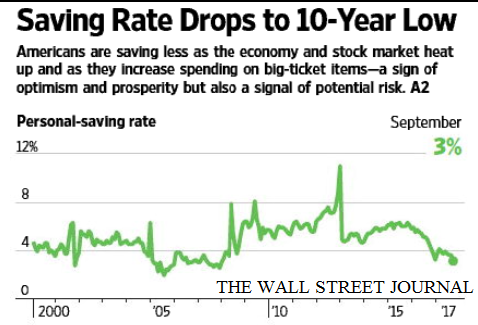
One interesting stat showed that the savings rate (the amount people save from each paycheck) dropped to a 10-year low.  Many investors see this as a positive, since it means higher spending and is a sign of confidence in the future.  We worry, though, that rainy days often come when you don’t prepare for them. 


Next Week

We’re getting towards the end of corporate earnings season, but there will still be a number of reports out next week as about 10% of the S&P 500 reports results.  Many media companies and retailers, in particular, will be reporting results.  The week will be a very quiet one for economic data.

More work will be done on the tax plan and we’ll be watching to see how it shapes up.


Investment Strategy

No change here.  We’ve been expecting to see a pause or decline in this market rally, but have clearly been wrong thus far.  We still think the market is on the expensive side and hesitate to put new money into the broader indexes.  However, there are many individual stocks that may be trading at attractive levels. 

Below is an update to some of the leading indicators we follow.  As the stock market rises, these indicators continue to move lower.  This shows investors are taking less risk and the stock market is becoming more susceptible to a large correction.  This is something to keep an eye on.   


Our longer term outlook remains positive, but less rosy than it was several months ago.  We’re encouraged to see pro-business reforms coming out of Washington, although they are increasingly becoming watered-down.  Additionally, companies have favored returning cash to shareholders through dividends and buybacks over the last several years and we believe the lack of reinvestment in their companies will weigh on earnings in the future. 

Bond prices remain on the low side on a short-term basis and yields are on the higher.   We don’t think yields have much room to move higher and think prices will firm up from here. 

As for the rest of the portfolio, bonds to protect against inflation, or TIPs, remain a good long term hedge for inflation.  Floating-rate bonds will do well if interest rates eventually do rise. 

Some municipal bonds look attractive for the right client, too.  We like buying individual, insured names for these bonds, avoiding muni index bonds if possible.  We keep a longer term focus with these investments. 

Gold is another good hedge for the portfolio.  It is only a hedge at this point – rising on geopolitical issues as a flight to safety. 

Finally, in international stocks, we see weakness around the globe and favor neither the developed or emerging markets, though they are looking cheap.


This commentary is for informational purposes and is not investment advice, an indicator of future performance, a solicitation, an offer to buy or sell, or a recommendation for any security. It should not be used as a primary basis for making investment decisions. Consider your own financial circumstances and goals carefully before investing. Past performance cannot guarantee results.


Friday, October 27, 2017

Commentary for the week ending 10-27-17

Stocks saw modest gains this week.  Through Friday’s close, the Dow rose 0.5%, the S&P inched higher by 0.2%, and the Nasdaq added a decent 1.1%.  Bond prices continue to fall, hitting their lowest level in five months as yields moved higher.  Gold was lower for another week, off 0.4%.  Oil prices rose this week, climbing 5.3% to $54.19 per barrel.  The international Brent oil moved higher to close at $60.50.
Source: Google Finance


Stocks were a little more volatile this week as they saw large daily swings.  The pullbacks in the market didn’t last long and were quickly bought, which can be seen as a positive sign.  There are a few things we are watching, though, which are discussed more in the “Investment Strategy” portion found later in this commentary. 

There was a little bit of everything impacting the markets this week.  Corporate earnings were a big story and we also saw a few important economic reports.  The central banks both here and abroad were also in focus. 

First we’ll touch on corporate earnings, with this being the busiest week of releases all earnings season.  There’s no question the results have been good.  Tech stocks were a bright spot this week as many in this sector reported results and most were well above expectations.

Below is an earnings summary from Thompson Reuters:


Economic data was mostly positive this week, too.  Durable goods (which are items with a longer life) saw an increase in sales of 2.2%.  Housing reports showed new home sales had their best month since 1992 (though no one really seemed to know why) and existing home sales slowed a notch.  Housing prices continue to climb, too.


The big economic data came on Friday with the release of the third quarter GDP figure.  Economists set the bar low, since no one was really sure how much impact the hurricanes would have on economic growth.  The result was a solid 3.0% growth, which was even better considering the impact of the storms during that period. 


As for the central banks, much of the focus was on the European Central Bank (ECB), who held a policy meeting this week where they were expected to talk about pulling back on their stimulus program.

The ECB has printed enormous sums over the years to purchase bonds to keep their yields low and have also implemented negative interest rates – something never before seen in the history of the world.  As the economy improves, however, they needed to step back from these extraordinary measures.  The stimulus has supported the markets, so getting out without upsetting them would be a tough task. 

In the end, they announced they would reduce the amount of money they are printing to buy bonds beginning in 2018.  However, they would keep buying bonds for as long as needed.  The open ended-ness of this statement was seen as a positive, so markets rose as a result.


Finally, our central bank, the Fed, was also in the news.  Fed chief Janet Yellen’s term ends early next year and President Trump is looking for a successor – and it’s playing out a bit like a scene from The Apprentice. 

It looks like the field of contenders has been whittled down to three finalists, one being Janet Yellen herself.  Another is Jerome Powell, who is currently on the Fed and is similar to Yellen.  The last is John Taylor, who has different views from much of the Fed members (but is more aligned with our thinking – he is more practical and less theoretical).  

An appointment of Yellen or Powell is likely to be seen as a positive by the markets since it signals continuity.  We think a Taylor appointment would probably be best in the long run, but may create more volatility in the market. 


Next Week

Next week will be another busy one.  Corporate earnings will continue to come in at a steady pace.  For economic data, all eyes will be on Friday’s employment report, but we’ll also get info on the strength of the manufacturing and service sectors, productivity, personal income and spending, and consumer confidence. 

We’re also expecting to hear President Trump’s choice for Fed chief.  He indicated the decision will come before November 4th, so it could come at any time next week.


Investment Strategy

No change here.  We’ve been expecting to see a pause or decline in this market rally, but have clearly been wrong thus far. 

Some of our indicators have begun to deteriorate, which is something we are keeping a close eye on.  The image below shows that as the stock market keeps climbing higher, these indicators are moving lower.  This shows investors are taking less risk and the stock market is becoming more susceptible to a correction.  This is something to watch closely. 


Our longer term outlook remains positive, but less rosy than it was several months ago.  We’re encouraged to see pro-business reforms coming out of Washington, although they are becoming more watered-down by the day.  Additionally, companies have favored returning cash to shareholders through dividends and buybacks over the last several years and we believe the lack of reinvestment in their companies will weigh on earnings in the future. 

Bond prices remain on the low side on a short-term basis and yields are on the higher.   We don’t think yields have much room to move higher and think prices will firm up from here. 

As for the rest of the portfolio, bonds to protect against inflation, or TIPs, remain a good long term hedge for inflation.  Floating-rate bonds will do well if interest rates eventually do rise. 

Some municipal bonds look attractive for the right client, too.  We like buying individual, insured names for these bonds, avoiding muni index bonds if possible.  We keep a longer term focus with these investments. 

Gold is another good hedge for the portfolio.  It is only a hedge at this point – rising on geopolitical issues as a flight to safety. 

Finally, in international stocks, we see weakness around the globe and favor neither the developed or emerging markets, though they are looking cheap.


This commentary is for informational purposes and is not investment advice, an indicator of future performance, a solicitation, an offer to buy or sell, or a recommendation for any security. It should not be used as a primary basis for making investment decisions. Consider your own financial circumstances and goals carefully before investing. Past performance cannot guarantee results.