Friday, October 1, 2021

Commentary for September, 2021

Hello all – we hope you had a nice September.  Hard to believe we’re already in October.  

It wasn’t a good month for the markets.  In fact, it was the worst month in a year-and-a-half.  The Dow fell 4.3%, the S&P 500 lost 4.8%, and the Nasdaq, which has a higher concentration of technology companies, was off 5.3%.


Stocks trended lower early in the month and like so many of the previous months, had a sharp drop in the middle of the month.  It quickly rebounded higher, just like previous months, but then reversed course again to close the month lower.  It was a very frustrating month for investing. 


_____
 
 
There were a few different news items contributing to the market decline.  

We’ll start with Washington, which grabbed a lot of headlines as politicians were very busy this month (that’s never a good thing).

First, there was a fight over the government funding bill in order to prevent a shutdown on October 1st.  After a lot of bickering, this was resolved at the last minute.  

Then there is the debt ceiling fight, which looks like it may have a mid-October deadline.  Similar to the government shutdown fight, this adds some volatility to the markets and is likely to be resolved at the last minute.

Finally, there was the proposed “infrastructure” bills (we use quotation marks since there’s not much traditional infrastructure in there).  These bills introduce a lot more government spending and a lot more taxes.  This is a concern for businesses and for investors who are almost certain to see higher taxes on their investments.  These higher taxes will be a headwind for the markets.  

____


A lot of the focus this month was on the Fed, too.  They’ve been talking about pulling back on their stimulus for quite some time, but this month they seemed to indicate they would begin the process in November.  

They’re currently printing $120 billion a month to buy bonds to keep borrowing rates down and in November they will start reducing the amount of money they print.  This money makes its way into the market and supports stocks, so a reduction will also be a headwind for the markets.  This added to the downward pressure this month.    

____


We haven’t talked about China much recently, but they also contributed to the decline in the markets.  

The largest property developer in China found itself in trouble this month and was unable to pay some of its debts.  Financial troubles are not uncommon in China, but the government often steps in to help out.  The government showed no willingness to help this time and investors were worried more business defaults were likely to follow.  

In the end, the company made some payments to its Chinese debtors but made no payments to anyone outside China.  The government didn’t seem to see anything wrong with that - and that could be a problem for its foreign relations.  

This issue has not been fully resolved and we’re likely to hear more from them in the coming weeks.  

____


Recent high energy prices around the globe are also a serious issue that haven’t gotten much attention in the U.S.  

Europe has been hit especially hard.  Coal and natural gas prices have risen exponentially in the region.  A push for “green energy” has led to less reliance on traditional energy sources, but the green energy hasn’t been able to provide enough power.  Low supply and high demand, as well as transportation issues, have led to record-high prices and shortages all across the continent.


China is in a similar boat as they have instituted lower energy-consumption targets.  Power outages were common this month as prices soared and regional governments limited power usage.  Not only is that inconvenient for the people, but many factories were forced to shut down for long periods of time.  For the first time since the pandemic started, the Chinese manufacturing sector actually contracted last month.     

The U.S. is following a similar path as the government requires more “green energy.”  Natural gas prices have risen sharply and oil is at the highest level in three years.  These shortages are expected to persist through the winter, so be prepared for higher energy prices.  These green policies are a big headwind for the economy. 


Worries about high energy prices reflect a broader concern about rising inflation.  By all accounts, inflation is at or near its highest level in more than a decade.

CPI, which measures inflation at the consumer level, took a slight turn lower over the past month, but it still stands near the highest level since 2008. 


Inflation at the business level, or PPI, has risen to its highest level in 11 years. 


Many businesses are warning about this inflation and are passing on the higher prices to customers. 


Take a look at how much it costs to ship a container from China to Los Angeles.  Last month we reported it cost about $11,000.  Now it costs more than $20,000!


There are growing concerns for the broader economy, too.  GDP projections for the third quarter have continued to decline.


Stagflation has become a popular word again as investors worry about lower economic growth and high inflation. 


The employment picture is weakening, too, as fewer jobs were added last month.


This is remarkable as there is a record amount of job openings. 


The trends in the economy are concerning. We are hopeful that these trends reverse, but fear that the economic proposals out of Washington will only create more headwinds.  

____


Where does the market go from here?  

This is a tough call.  The fall is the most volatile period for the markets and September lived up to that billing.  Stocks are on the oversold (or cheap) side from a short-term perspective, but it’s not easy to stick your neck out too far here.   


This commentary is for informational purposes and is not investment advice, an indicator of future performance, a solicitation, an offer to buy or sell, or a recommendation for any security. It should not be used as a primary basis for making investment decisions. Consider your own financial circumstances and goals carefully before investing. Past performance cannot guarantee results.

Wednesday, September 1, 2021

Commentary for August, 2021

Hello all – we hope your August was nice.  

The markets continued their march higher this month.  The Dow rose by 1.2%, the S&P 500 gained 2.9%, and the Nasdaq, which has a higher concentration of technology companies, rose a solid 4.0%.


Also like previous months, August had a swift drop in stocks and an equally swift rebound.


_____
 
 
Looking at a chart of the market over the past year shows something very unusual - a market that has moved higher in practically a straight line. 


A major reason for the steady rise in markets is the stimulus from the Fed.  Interest rates are at historic low levels and they are printing $120 billion a month in stimulus.  This helps inflate the market. 


That was the main focus of investors this month - the Fed and their stimulus.  The economy has improved and they’ve hinted a pullback in stimulus would be coming, but investors are anxious to find out when.  

Investors expect the $120 billion printed each month to be reduced soon.  Commonly referred to as a ‘taper,’ a reduction in this stimulus would likely send markets lower.  We saw this in 2013 - a taper was announced and the markets quickly fell.  Ultimately the Fed never tapered and the markets moved higher. 


Investors are looking for any clues of a taper so they can get out quickly before markets fall like they did in 2013.  

In the end, we didn’t learn much new about a taper this month.  The Fed indicated it would be coming soon - probably before the end of the year - but not in the immediate future.  Investors took this as a good sign and the market rallied.      

_____
 
 
One of the main things the Fed focuses on is inflation.  They want to see inflation around 2% (you know we argue it should be 0% or even slightly negative, but we digress…) and inflation has been much higher than 2%.  Inflation at the consumer level (the CPI) came in at 5.4% for the second-straight month.  Many people believe inflation is too high, but the Fed believes it is temporary and are not concerned. 


Inflation at the business-level (or PPI) is even higher, standing at 7.8% over the past year.  That’s high!


There’s a lot of signs of high prices out there but an interesting one we saw this month is shipping container costs.  Yes, it’s random, but interesting since the items we buy in stores must be shipped from somewhere.  

In this example, the cost of a shipping container going from China to Los Angeles went from under $2,000 to about $11,000.  Imagine what that does to the price of something you buy in a store? 


Another metric important to the Fed is employment.  They want to see employment improve before pulling back on their stimulus.  

Employment has been improving but at a slower pace than they’d like to see.  We think a major reason for this is the enhanced unemployment benefits which pay people more to not work.  A monthly employment report shows there continues to be more jobs available then there are people out of work. 


As for other economic data, the picture still looks decent, but slowing.  

A leading indicator we look at for the economy is the amount of people dining out.  That level has slowed since June.


The manufacturing sector is slowing, too…


…but the service side of the economy is doing well.
 

Retail sales took a turn lower:


As did durable goods, which are items that have a longer life:


Sentiment dipped, too.


 _____
 
 
Where does the market go from here?  

We’re entering the most volatile part of the year with a lot of news items that are sure to add to the volatility. 


In September we’re likely to hear more about a pullback in the Fed’s stimulus and that’s sure to impact the markets.  Plus, the focus in Washington will be on their massive spending bills and the battle over the debt ceiling, which could cause a government shutdown at the end of September.  There’s sure to be some fireworks there.


Stocks are on the expensive side from a short-term perspective, but we aren’t seeing the red flags that usually appear before a big pullback.  We wouldn’t be sellers here, but would be cautious before putting any new money into the market.  


This commentary is for informational purposes and is not investment advice, an indicator of future performance, a solicitation, an offer to buy or sell, or a recommendation for any security. It should not be used as a primary basis for making investment decisions. Consider your own financial circumstances and goals carefully before investing. Past performance cannot guarantee results.

Monday, August 2, 2021

Commentary for July, 2021

Hello all – we hope you had a nice July.  Hard to believe we are already into August.  

Stocks continued their march higher.  For the month, the Dow was up 1.3%, the S&P 500 rose 2.3%, and the Nasdaq, which has a higher concentration of tech companies, gained 1.2%.


Our newsletter last month discussed a few red flags we were seeing.  Several indicators we followed were moving lower.  Also, the overall market was rising but fewer and fewer stocks were participating in the rise.  This often occurs before a fall in the market.

These concerns were justified as the markets did fall sharply, as you can see in the chart below.  The indexes had their biggest one-day drop since last October. 


However, the fall was short-lived.  Investors quickly bought the dip and markets rebounded strongly to close the month with decent gains.  

Right now we aren’t seeing the red flags we saw before.  The economy seems to be in decent shape and corporate earnings have done well.  There are new concerns with the Coronavirus and the Fed may be a step closer to pulling back on its stimulus and that could send stocks lower.  We’ll talk about these more later.  

_____

 
We’ll start with corporate earnings.  Results for the second quarter began coming in this month and about half the companies in the S&P have reported so far.  

Companies have done much better than expected, although accurate predictions have been tough to make coming out of the pandemic.  While earnings are good now, there’s a concern that earnings may have reached their peak.  Many companies are warning of high inflation and that they see sales slowing in the future.  This is something to keep an eye on.  

_____


The Fed was also in the news this month as they held one of their policy meetings.  No change in their stimulus policy was announced - as expected - but they seemed closer to pulling back on the stimulus.


Investors have been watching the Fed closely for clues as to when they’ll reduce stimulus since many of the targets the Fed has set have already been reached or surpassed.  Inflation is running at levels we haven’t seen in over a decade and economic growth is strong.   

During the Fed meeting, many reporters asked for specifics on their policies but the Fed never gives a straightforward answer.  Is the sky blue?  It might be today, but it might not be tomorrow.   

They acknowledged the progress in the economy, but noted that it wasn’t enough.  Inflation is high now, but they expect it to recede in the future (they never define when that is).  Also, they expressed concerns about high unemployment, but we believe that’s not a sign of weakness in the economy and is due more to attractive unemployment benefits from the government.  

Our take is that while inflation is high, it will never be a concern to the Fed since they will always believe inflation will be lower in the future.  We think their focus is on employment.  Solid employment reports will force the Fed to pull back on stimulus, but even then it might be by a tiny amount.  The Fed has recently introduced minority unemployment as another metric they follow and it’s always higher than the average, so they can continue to cite that as a concern.  

Frankly, we think the Fed is looking for any excuse to not pull back on stimulus.  They are trapped - they know the stock market will fall if they do and higher borrowing costs on the enormous amount of debt in our system will slow the economy.   We think all this money printing will eventually cause significant problems, but its anyone’s guess as to when that will be.  

_____

 
Switching gears to economic data released this month, we’ll start with inflation.  Last month’s report saw a 5% annual increase in inflation, the highest in 13 years.  This month’s report was even higher at 5.4%.  Remember, the Fed wants 2% inflation (which we believe is a bad policy and the target should be 0% - or even negative).


The GDP report measures the strength of the economy and it came in at a solid 6.5% for the second quarter.  Economists are warning that this could be the peak in GDP, though. 


With all the concern over high unemployment, there sure are a lot of job openings out there.  More than 9 million, in fact, and we have about 8 million unemployed. 


The manufacturing and service sectors are both growing, though at a slower pace than recent months. 


People are still out shopping as sales are rising.


Despite higher prices from inflation and new Covid headlines, optimism is surprisingly strong.


_____


Where does the market go from here?  

We continue to think the markets will have a tougher time going forward.  The threat of a pullback in stimulus hangs over the market and every economic report will be scrutinized for how it will influence the Fed.  Bad economic data - especially employment figures - will be good for the market.  We aren’t too enthusiastic on the market at this time.  


This commentary is for informational purposes and is not investment advice, an indicator of future performance, a solicitation, an offer to buy or sell, or a recommendation for any security. It should not be used as a primary basis for making investment decisions. Consider your own financial circumstances and goals carefully before investing. Past performance cannot guarantee results.

Thursday, July 1, 2021

Commentary for June, 2021

Hello all – we hope your June was a nice one.

It was another decent month for the markets, with the S&P and Nasdaq reaching record highs and the Dow near its high.  The Dow had a slight decline of 0.3%, the S&P 500 gained 2.3%, and the Nasdaq was up 5.2%.  

The end of June was also the end of the 2nd quarter.  It was a good quarter for the markets, with the Dow climbing 4.6% in the three months, the S&P gained 8.6%, and the Nasdaq returned a solid 11.2%.


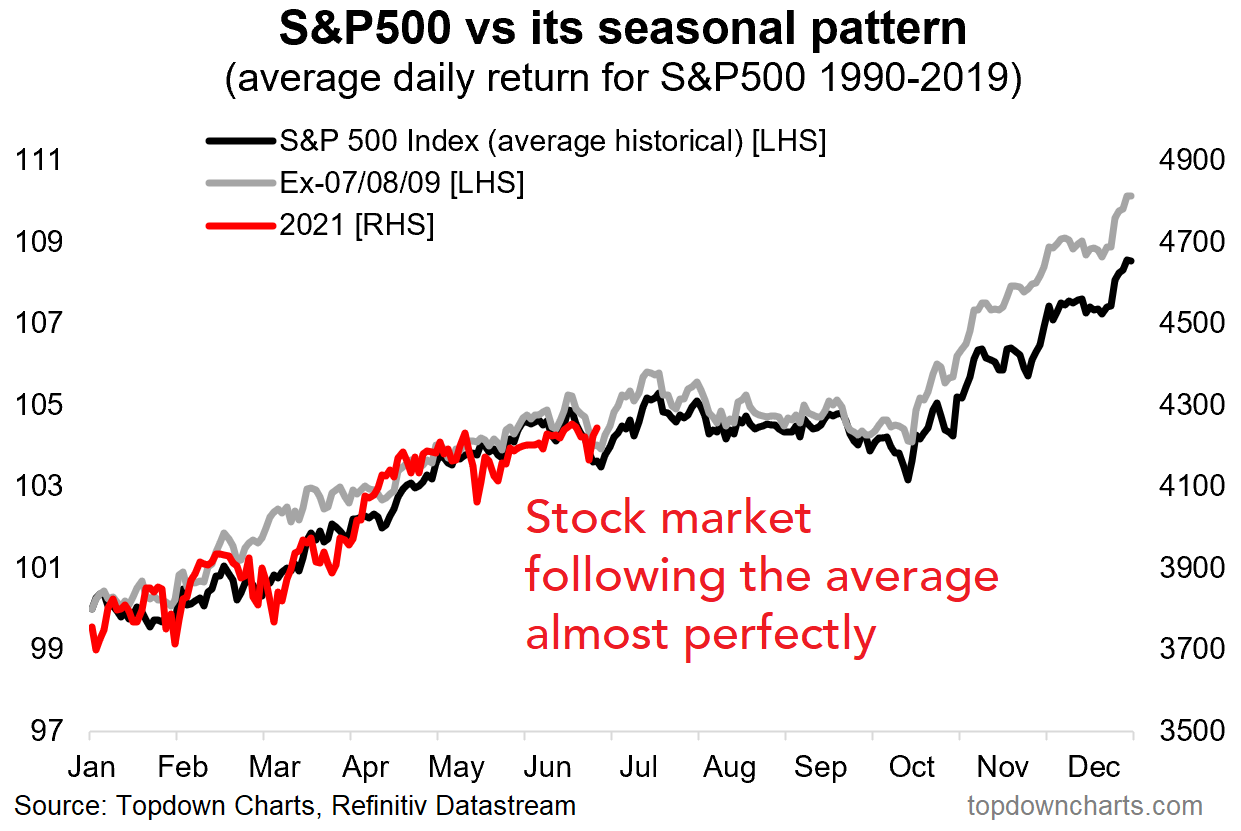
Interestingly enough, the S&P 500 index is following its historical average almost perfectly this year.


_____
 
 
The record highs in the indexes are a bit misleading in how stocks are really performing.  Fewer and fewer stocks are rising and the records are coming from a rise in just a handful of stocks.  70% of stocks are below the index, which means only 30% of stocks are above the index. In fact, there were days this month where the market would be higher, but all of the individual stocks we owned were lower (those are the days you question your own existence).

This is a big red flag for the markets.  You want to see more stocks rising when the index is rising.  It’s like building a house on a weak foundation - eventually it will collapse.  

The chart below shows the Advance-Decline line (the red line), which tracks all the stocks moving higher versus the ones going lower (it’s commonly referred to as “breadth”).  When we compare it to the S&P 500 (the black line), we can see how they tend to move together.  When the Advance-Decline line (A-D line) moves lower, it usually signals the broader markets will fall, too.   


_____
 
 
There are a few other indicators we follow that are raising red flags, too.  One is the Transportation index, which is basically just an index tracking transportation-related stocks (like FedEx, Delta, CSX Rail, J.B. Hunt Transports, etc.).  It tends to follow the broader market, too, but a deviation where it moves lower and the broader market moves higher is usually a sign that the broader market will move lower.  

We’ve seen a big divergence lately, which is a bad sign for the market.


Before you think it’s all bad news out there, high-yield bonds (the riskiest bonds) are also a good indicator for the broader market and they’ve been pretty solid. 


So while it’s not all bad news, the handful of red flags are enough to make us a little cautious.  

Despite the red flags - we think the fate of the market lies with the Fed and their policies, which we’ll discuss shortly.  

_____
 
 
First, we need to talk about inflation, which was the big story this month.  The CPI inflation report released this month showed inflation rising 5% over the past year, the highest in 13 years. 


Inflation is one of the main metrics the Fed looks at to determine their stimulus policy, so a high level of inflation would lead them to pull back their stimulus.  This is important because the stimulus has been responsible for much of the rise in the market.

The Fed held a policy meeting this money and they did indicate that they would be pulling back on their stimulus by raising interest rates - by the end of 2023.  2023 sounds like a long way off - and it is - but it’s a sign that the party WILL be coming to an end at some point.  That’s enough to worry the markets.   


We’ve often seen the Fed make a statement that rattles the market and realize the reaction isn’t what they intended.  In those cases, Fed members would make TV appearances to soothe investors.  That didn’t happen this time.  In fact, most of the Fed speakers that appeared on TV indicated that inflation was a concern and they’d like to pull back on the stimulus even faster.  

Their take was completely rational.  Inflation is high and there is no need for these crisis-level stimulus measures.  A reduction in stimulus would be good for the health of the economy, but a stock market addicted to stimulus will not fare well as stimulus is removed.  

____


That brings us to the economy.  In light of the Fed’s new stance, bad economic data will likely see the market rise since it would make the Fed less likely to pull back on stimulus.  

Employment will be an important metric to watch.  The Fed cites high unemployment as a concern, and while hiring has improved somewhat, it is still sluggish.  We can argue about the cause of high unemployment, but there is a record amount of job openings in this country.  We believe that hiring will pick up when unemployment benefits wear off.


Here’s a look at many other economic indicators, with most showing an improvement.


 _____
 
 
Where does the market go from here?  

We think the markets will have a tougher time going forward from here.  In the short term, market internals like breadth are flashing red.  Plus we have a Fed that seems likely to pull back on stimulus.  There aren’t a lot of positive catalysts out there now.  Poor economic reports or explicit comments from Fed disavowing a pullback in stimulus will likely put some wind back in the sails of the market.  


This commentary is for informational purposes and is not investment advice, an indicator of future performance, a solicitation, an offer to buy or sell, or a recommendation for any security. It should not be used as a primary basis for making investment decisions. Consider your own financial circumstances and goals carefully before investing. Past performance cannot guarantee results.