Monday, May 1, 2023

Commentary for April, 2023

Hello all - we hope you had a nice April.

The month was a relatively quiet one.  The Dow gained 2.5%, the S&P 500 rose 1.5%, and the Nasdaq, which has a higher concentration of tech stocks, added just 0.1%. 


Here’s a look at how the markets moved this month:


And here’s the sector performance for the month (Comm services is the communications sector, which includes names like Facebook and Google, who had solid gains near the end of the month):


____

After the banking crisis sent markets all over the map last month, this month was looked incredibly tame.  The market saw little volatility and there were few newsworthy headlines.  The Fed was very quiet this month, too, and had no impact on the markets.  

Economic data was generally lower, with most inflation lower, too.

The main topic this month was corporate earnings as results from the first quarter started coming in.  We’ll discuss that next.   

____

EARNINGS

About half the companies in the S&P 500 have reported their earnings results so far.  The results haven’t been that bad.  Well, relatively speaking.  

Analysts expected company earnings to be down about 6.8% on average, according to analytics company Factset.  However, so far company earnings have been lower by about 3.7%.  Lower earnings are never good, but its all about beating expectations, which they did.

Earnings results have varied by sector.  Banks have not been as bad as thought, while sectors like energy and technology have fared pretty well.

One trend that continues is companies are selling less items, but have raised prices so much that they are actually earning more.  This trend cannot last, but we’ve been saying that for a few quarters and this has yet to be the case.  The image below is a headline highlighting this very subject.   

____

INFLATION

We’ll first look at inflation before getting into the other economic data.  As you can see in the chart below, inflation continues to move lower. 


However, that is looking at inflation on an annual basis.  When you look at inflation month-by-month, inflation is still rising every month.  It rose only slightly last month, but it’s still an increase. 


Inflation is also steadily rising when we exclude food and energy from the calculation (which economists call the “core” measurement). 


One bright spot is inflation at the business level, or PPI, took a sharp turn lower.  This could mean lower prices for us soon.   


____


ECONOMIC DATA

The data released this month shows an economy that continues to slow.  

We’ll first look at an indicator we’ve discussed a lot recently, which is the leading economic indicator index.  It combines many other indicators that tend to signal the direction of the economy (like weekly unemployment numbers, building permits, etc.).  

This index has been lower for 12-straight months.  As you can see in the chart below, it never goes this low without a recession following (a recession is marked by the gray shaded areas in the chart).


We can see the economy slowing with the GDP report, which shows the strength of an economy.  Last quarter saw the economy grow just 1.1%.  Combine this low growth and high inflation and you can safely say we are in a “stagflation” period. 


Both the manufacturing and service parts of our economy moved lower last month, with the manufacturing sector firmly contracting. 


Retail sales fell again last month.


Durable goods (these are items with a longer life, like a phone or refrigerator) were the one bright spot.  They showed a solid gain last month, although this was more due to some large airplane orders.     


Consumer confidence moved lower last month after it looked like it might be starting to trend higher.


Confidence at small businesses continues to languish.


____


Where does the market go from here?

In the very short term, stocks may have some room to pop higher, but we aren’t too enthusiastic.  A big Fed policy meeting later this week may help set the tone for the month.  Investors think the Fed will back away from their reduction in stimulus and will signal an end to their increases in interest rates.  We aren’t so sure.  It will be something to watch closely.  


This commentary is for informational purposes and is not investment advice, an indicator of future performance, a solicitation, an offer to buy or sell, or a recommendation for any security. It should not be used as a primary basis for making investment decisions. Consider your own financial circumstances and goals carefully before investing. Past performance cannot guarantee results.

Monday, April 3, 2023

Commentary for March, 2023

Hello all - we hope you had a nice March.

It was a very volatile month for the markets, though they ultimately posted decent gains.  For March, the Dow gained 1.9%, the S&P 500 rose 3.7%, and the Nasdaq, which has a higher concentration of tech stocks, added 4.9%.  

We also ended the first quarter of 2023, with the markets having a wide divergence in how they performed.  Over the first quarter, the Dow rose 0.4%, the S&P 500 gained 7%, and the Nasdaq was higher by 17%.  That gap between the Nasdaq and Dow was the widest in over 20 years.   


Here’s a look at how the markets moved this month:


And here’s the sector performance for the month:


Amid all the volatility, investors flocked to the safety of bonds as the sector saw solid gains in prices. 


When bond prices rise, their yields fall.  This month, bonds with a shorter maturity saw their yields drop by the largest amount in decades.  Unfortunately, other drops of that size were during massive crises in our economy. 


_____

BANKING CRISIS

By now you’ve heard about the banking failures earlier this month, so we won’t go into the how’s and why’s of what happened.  Its impact of on market was tremendous, however.  In the early part of the month, we saw daily headlines like this:


As the month progressed, numerous bailout packages, buyouts, and government assistance and pledges helped put out the fire.  Investors now believe the worst is behind us – at least in the near term – and stocks rose as a result.  

By the end of the month, the headlines looked like this:


____

THE FED

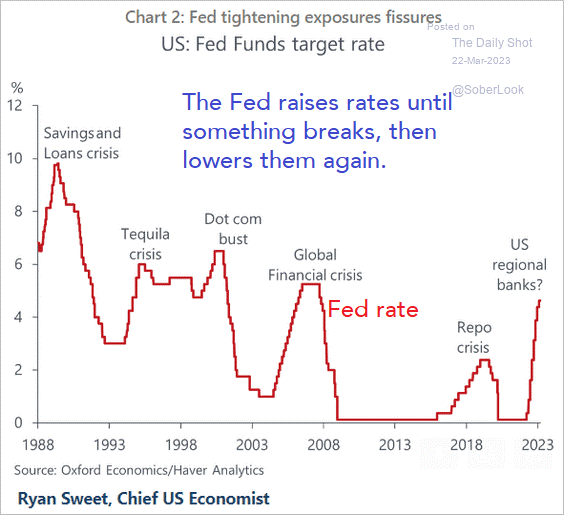
There is a saying that the Federal Reserve raises interest rates until something breaks. They’ve raised rates at a record pace and this month, something finally broke.

Here’s a look at the history of Fed hikes, the resulting busts, and subsequent reversal on rates:


This chart goes back even further:


As you can see from the charts, sudden increases in rates always results in something breaking.  

The bank failures actually had investors optimistic that the Fed would be done raising interest rates (lower rates helped fuel the market rise over the last decade).  

Unfortunately, the Fed announced another rate hike this month.  While they’re continuing to raise rates at a historically fast pace, they seemed to indicate that the pace of rate hikes would slow down in the future.  Investors liked that and stocks moved higher as a result. 


____

ECONOMY

It’s not just the banking sector investors are worried about, but the overall economy in general.  There are many red flags that have investors concerned a recession is right around the corner.    

A very reliable indicator is the yield curve.  We’ve discussed this one before and it can be a little wonky.  We won’t go into details about what the yield curve is, but it is basically the relationship between bonds of different maturities.  

The relationship between the 10-year and 2-year bond is the most common way to look at the yield curve.  When this relationship is negative, a recession always follows.  More specifically, when the relationship is negative and quickly becomes positive, a recession is near.  

The chart below shows this.  A recession is marked by the blue bars and you can see, as the line goes below zero and quickly moves higher, a recession occurs.  

This month we saw the negative relationship quickly reverse and the line move higher.  Does that mean a recession is near?


We aren’t so sure that a recession is imminent.  

Instead of looking at 10-year and 2-year bonds, another reliable indicator is 10-year and 3-month bonds.  In the chart below, you can see it follows the same pattern as the 10s/2s, going negative and rising before a recession.  However, right now this indicator doesn’t have the quick rising line. 


We do believe a recession is likely soon, but it may not be as soon as some think.  

____

 
INFLATION

The Fed wants inflation to come down and they closely watch the inflation reports each month.  That means investors closely watch them, too.  

We’ll start with a look at inflation from an annual perspective.  As you can see, inflation looks like its trending lower.


However, when you look at inflation month-by-month, inflation is clearly not slowing down.


The “core” measurement, which excludes food and energy, continues to see solid monthly increase in inflation.


Inflation at the business level, or PPI, looks like it might be stabilizing. 


____


OTHER ECONOMIC REPORTS

We continue to see signs the economy is slowing, although there were a couple bright spots this month.

First is an interesting look at the job situation at companies.  Last year they were mentioning they didn’t have enough people to hire, but this year they are announcing more job cuts. 


Another indicator we’ve been discussing recently is the leading economic indicator index.  It combines many other indicators that tend to signal the direction of the economy (like weekly unemployment numbers, building permits, etc.).  

This index has been lower for 11-straight months.  That has happened only three other times, and each of these were in recessions. 


The manufacturing part of our economy stands firmly in a contraction, but ticked slightly higher while the service part of our economy had a slight move lower. 


Retail sales fell after a surprising gain the previous month.


Durable goods (these are items with a longer life, like a phone or refrigerator) saw another decline.   


Consumer confidence may be starting to trend higher. 


Confidence at small businesses saw a slight tick higher from last month.


____


Where does the market go from here?

Stocks may be a little on the expensive side in the short term, so we wouldn’t be looking to put new money in here.  This time of the year works in investors’ favor, however, as it tends to be a strong period for the markets. 


This commentary is for informational purposes and is not investment advice, an indicator of future performance, a solicitation, an offer to buy or sell, or a recommendation for any security. It should not be used as a primary basis for making investment decisions. Consider your own financial circumstances and goals carefully before investing. Past performance cannot guarantee results.

Wednesday, March 1, 2023

Commentary for February, 2023

Hello all - we hope you had a nice February.

Stocks opened the month higher, only to turn around and move lower and close in the red.  For the month, the Dow lost 4.2%, the S&P 500 fell 2.6%, and the Nasdaq, which has a higher concentration of tech stocks, also saw a decline of 2.6%. 


Here’s a look at how the markets moved this month:


And here’s a look at the performance of the different sectors for February:


_____

Economic reports seemed to have the most impact on markets this month.  Reports showing good news or high inflation were met with lower markets.  Remember, the better the news, the more likely the Fed is to keep pulling back on its stimulus.  For a market addicted to stimulus, good news is bad news.

We’ll get to the economic data later.  For now, we’ll start with corporate earnings.  

____

CORPORATE EARNINGS

We’ve received nearly all the corporate earnings for the fourth quarter.  The overall result was a decline in earnings of nearly 5%, larger than was expected.    

Companies have seen decent revenue (which is the amount of money they brought in).  However, they’ve made more money because they’ve raised their prices and don’t seem to be selling as many products.

This isn’t a positive trend.  Many companies warned that sales were slowing and they can’t raise prices much more, so their earnings are likely to be weaker later this year.  This could weigh on the markets in the future.  

____

THE FED

The Fed held another policy meeting this month where they raised interest rates by 0.25%.  This is a slowdown from the prior increases, but as you can see in the chart below, it’s still been a remarkable rise in borrowing costs.


____

INFLATION

The Fed wants inflation to come down and is closely watching these reports.  Unfortunately, the inflation numbers released this month suggest inflation is picking up again.  Several Fed members suggested the Fed should raise interest rates even more than many investors expected and stocks fell on the news.

We’ll start with a look at inflation from an annual perspective.  As you can see, inflation looks like its trending lower.


However, when you look at inflation month-by-month, inflation is clearly not slowing down.  Additionally, last month saw a negative inflation number and that was encouraging.  Unfortunately, that number was revised higher this month.  That means we’ve only seen one month where prices were lower in the last three years – and that was only a very slight decline.


The “core” measurement, which excludes food and energy, continues to see solid monthly increase in inflation.


Inflation at the business level, or PPI, showed a sharp rise last month, too.


Finally, another measurement of inflation the Fed likes to look at is the PCE inflation index.  We won’t get into the why’s and how’s of this measurement, but we can just look at the chart below and see that it continues to rise.


____


ECONOMY

We continue to see signs the economy is slowing, although there were a couple bright spots this month.

We’ll start with an indicator we brought up last month - the leading economic indicator index.  It combines many other indicators that tend to signal the direction of the economy (like weekly unemployment numbers, building permits, etc.).  

This index has been lower for 10-straight months.  That has happened only three other times, and each of these were in recessions. 


A bright spot this month was employment.  The monthly jobs report showed a solid increase in hiring.  Of course, good news is bad news for the market and stocks sold off as a result.


The manufacturing part of our economy stands firmly in a contraction, but the service part of our economy showed a surprising rebound.  


Retail sales rebounded, too, and posted a solid gain.


Durable goods (these are items with a longer life, like a phone or refrigerator) saw a sharp decline from the previous month. 


Consumer confidence had been trending higher since the middle of 2022, but had another decline last month. 


Confidence at small businesses saw a slight tick higher from last month.


____


Where does the market go from here?

In the short term, stocks look to be on the cheaper side of the range they’ve been trading in.  That doesn’t mean they can’t keep going lower, but we think the odds of an increase are higher than a decrease.  We'd like to see a little buying, first, before we dip our toes in, though. 


This commentary is for informational purposes and is not investment advice, an indicator of future performance, a solicitation, an offer to buy or sell, or a recommendation for any security. It should not be used as a primary basis for making investment decisions. Consider your own financial circumstances and goals carefully before investing. Past performance cannot guarantee results.